 Is Your Buck Ready for the Breeding Season?
 .
It is that time of year, the days are getting shorter, the weather is getting crisper and there is love in the air on the goat farm…ok…that isn’t exactly love I smell near the buck pasture. Those big boys have been blubbering and calling to the does across the farm. They have spent a great deal of time spraying themselves with urine and making sure their eau de la buck funk is potent enough to make them irresistible to every pretty doe on the place as well as peel the paint right off the barn walls. But how much time have you spent making sure your bucks are ready for breeding? An unhealthy buck may not be “up to the job” and illness may even cause him to be temporarily infertile.
The development of spermatozoa within a buck’s reproductive tract takes about 8 weeks; so for optimal spermatozoa production, preparation should commence at least 2 months prior to using him for breeding. In general bucks will become more active in the fall when most does are cycling. This will vary with some breeds such as the Boer that have the ability to breed year round, but no matter what breed or time of year, it is important to make sure bucks are in good condition and health before they are turned out in the doe pasture. Check through the following list to ensure your buck is truly ready to start work.
1. Nutrition & body condition
During rut, bucks have one thing on their mind, therefore activity levels go up and often less time is spent foraging and eating. It is not uncommon for bucks to lose condition during rut. Therefore, they need to be in good body condition and physical shape before the season starts. About two months prior to breeding, check your buck’s body condition. Don’t rely on sight alone but feel over his back and the bones of his spine, also check the conditioning over his ribs and hips. The buck should have some extra condition but not be overly fat, which could make him sluggish and more susceptible to heat stress during the breeding season. It is just as important that he not be too thin either or he will lack the reserves to get through both breeding and winter. Adjust his feed accordingly.
2. Hoof care & general health inspection
A buck’s hooves are often a forgotten aspect of preparing him for breeding, but it is important that your buck’s hooves are trimmed and examined prior to the breeding season. Problems such as overgrown hooves, sores or hoof rot will cause him pain and might hinder him from seeking out does in the pasture and breeding them. Start with a good hoof trim well in advance of when he is to be used for breeding, this will give you time to address and treat any problems you may find. While you have him restrained for this it is a good idea to also check his legs and joints and note any unusual swellings, then check his teeth, eyes and over-all soundness for any issues that may need addressed prior to the breeding season.
3. Vaccinating & Parasite Control
Worming bucks before the start of the breeding season is important because a heavy parasitic infection will also reduce a buck's performance, therefore bucks should be checked for both internal and external parasites. Look for a rough hair coat, excessive scratching and lice and treat if needed. To check for anemia caused by blood sucking parasites, namely the barber pole worm, pull the lower eyelid down and look at the inner eyelids which should be bright pink to red in color. If they are pale pink or grey the goat is anemic and most likely needs wormed and treated for anemia. Since not all internal parasites cause anemia, it is also a good idea to have a fecal sample checked to get a good idea of how many and what internal parasites your buck may be carrying and treat accordingly. Bucks should also be vaccinated against enterotoxemia and tetanus. We vaccinate our bucks at the same time we do the does so we know we never overlook keeping their vaccinations up to date.
4. Pre-breeding soundness exam
As the breeding season approaches it is a good idea to observe bucks for normal urination as well as normal behavior such as calling and spraying urine on their front legs and beards. If you are new to goats, ask your vet to show you how to check the buck’s penis and testes. If you feel comfortable in doing this yourself you can start by sitting the buck on it’s rump with its back to you, an assistant will make this easier. Examine the buck’s testes. They should be about the same size and fairly firm. There should not be any lumps, swellings or sores as abnormalities could indicate that the buck is unsound for breeding. Next examine the sheath and penis; the skin should be healthy with no sores or scabs. If any problems are found the buck should be examined by a veterinarian in plenty of time to find a replacement buck if necessary.
It is important to remember that without the buck, there would be no kid crop; often bucks go unnoticed until just prior to their use. Having a plan and keeping an eye on your buck’s health, condition and hooves year round with breeding soundness examinations prior to turning him out with the does will help to ensure high kidding rates and a good kid crop for you in the spring.
By Jennifer Fulton
All Rights Reserved.
 "You talking to me?"

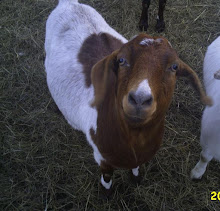


 There has been some changes and new projects happening on the farm. For starters the sweet, red wether "Pumpkin" went to new pastures and a great new home a couple weeks ago. He is now living just north of Wichita where he is a companion to a young Nubian buck and when he gets older he will help his new owner's other goats to clear their land of weeds and brush.
 Sunflowers
  Is Your Buck Ready for the Breeding Season?

 Posts
Posts


